Can vibecoding ship a real product in one sprint? We tested it
We built Sway to find out.
We wanted to test how AI changes product work on something real.
So during AI Business Builders, we gave ourselves one sprint, a concrete product idea, and a simple rule: build as far as we can using vibecoding and AI agents, without writing code by hand.
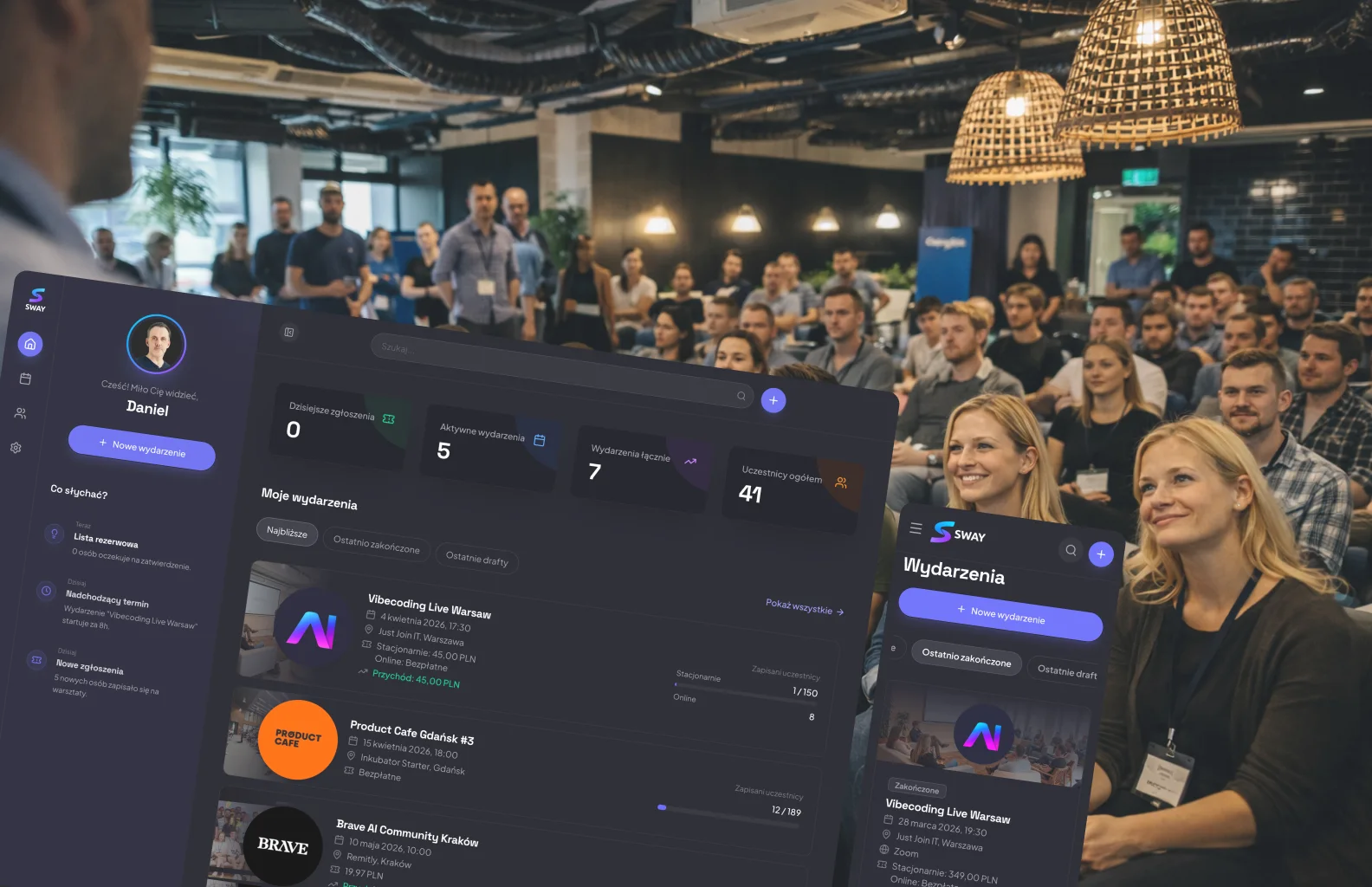
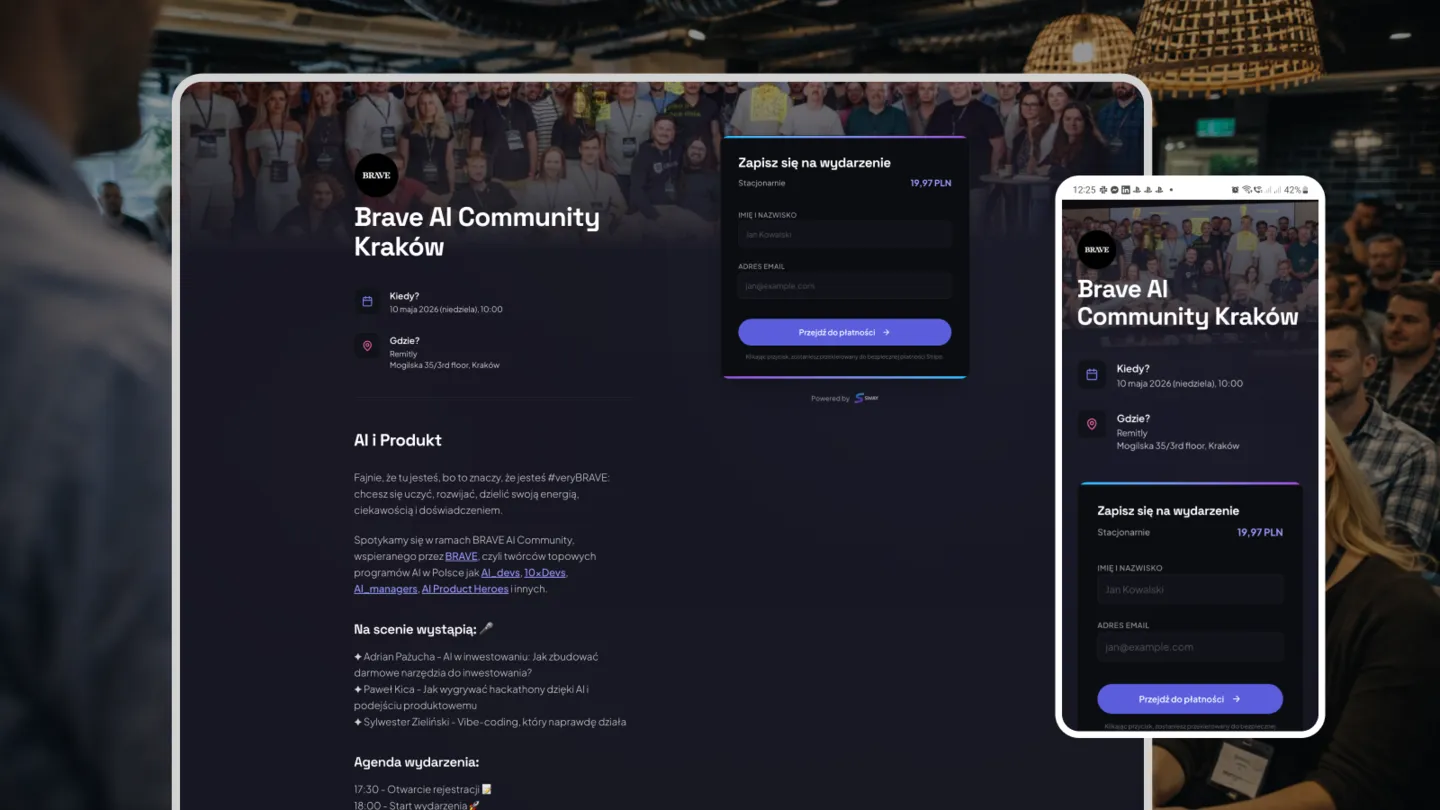
The result was Sway, a working tool for organizers of recurring meetups, with event setup, public landing pages, registrations, payments, tickets, QR check-in, mailing, roles, and a dashboard.
It was our own project, by design.
We wanted to see what happens when product designers stop treating AI as something to discuss and start using it to make product decisions, test flows, connect integrations, and ship something that actually works.
What we built
Sway started from a repeated operational problem.
Meetup organizers often rebuild the same process for every edition: sign-ups, payments, participant lists, ticket confirmations, emails, check-in, and follow-up communication. The work is straightforward once. It becomes difficult because it repeats, often across several disconnected tools.
Sway turns one event setup into a full operational flow.
An organizer creates an event, sets the date, format, number of seats, and price. From there, the system creates a public event page with branding, description, and registration, plus a management view inside the app.
Participants can register, pay, and receive a ticket with a QR code without creating an account. Organizers can manage sign-ups, payments, seats, emails, the event program, and attendance. After the event, they can review participation data and duplicate the setup for the next edition.
That was the product idea: a repeatable system for people who organize events again and again.
The experiment started before the build
The first useful AI agent challenged the product idea before any code was generated.
Before we opened the builder, we used ChatGPT as a strategic product reviewer. Its job was to question the problem, target group, business model, and scope, finding weak spots before they became product decisions.
Some ideas did not survive that conversation. Others became clearer.
This was one of the first useful lessons from the sprint: vibecoding makes weak product thinking visible faster.
A vague brief becomes vague software. An unclear role becomes a permission problem. A missing business rule becomes a broken flow. So before building, we worked through the product logic: user roles, core paths, payments, communication, check-in, limits, edge cases, and what should stay out of scope.
The brief was what made the speed of vibecoding usable.
AI moved fast. We still had to direct it.
Once the direction was clear, the first visible results came quickly.
The landing page was built in a day with branding, product communication, a blog CMS, and waitlist registration. The app followed with payments, emails, roles, dashboards, and QR check-in.
There were moments where vibecoding felt almost unreal. Stripe, Resend, PostHog, dashboard logic, and backend pieces moved much faster than they would in a traditional build. Plan mode helped because we could discuss the approach before code was generated. Without it, the structure becomes visible only after something breaks.
Speed shifted the design work, while keeping it in place.
The most useful product review was a whiteboard with generated screens arranged into real user journeys. That made gaps visible immediately: missing states, disconnected paths, unclear ownership between event settings and organizer settings, payment statuses hidden in the wrong place, roles that worked technically while failing operationally.
After that, the work became more precise. We stopped asking AI to "fix the app" and started moving screen by screen, flow by flow, with concrete acceptance criteria.
What vibecoding made easier
Vibecoding was strongest when the goal was already defined.
It helped us move from specification to working software quickly enough to test the product as a system, with all its parts working together. We could check registrations, payments, emails, roles, and check-in in context, then adjust the flow based on what actually happened.
That changed the rhythm of product work.
We had to move constantly between strategy, UX, interface, and implementation. A business rule affected the database. A user role affected the interface. A missing edge case affected the whole flow.
For two designers, that was valuable. It forced product thinking, design judgment, and technical reasoning to happen close together.
What still made it hard
The hardest part was uneven quality.
Some complex things worked surprisingly well. Some simple things took too long. A small UI issue could become more stubborn than a payment integration. A rule clearly written in the specification could be missed in the implementation. A working flow could break after a minor change somewhere else.
This is where vibecoding becomes a matter of controlling the product as it forms.
You need to notice when the system is building the wrong thing, when it is solving the wrong problem, and when it is technically working while no longer matching the product logic.
That kind of review cannot be outsourced to the agent.
One sprint in numbers
- 1 day – From early idea to detailed specification.
- 1 day – Landing page with branding, product communication, blog CMS, and waitlist.
- Around 1.5 weeks – Working app with payments, mailing, roles, event dashboard, and QR check-in.
- $242 – Total Replit cost: around $22 for the landing page and $220 for the application.
- The cost was low compared to a traditional build. The effort was high.
- This was a focused sprint of briefing, prompting, reviewing, testing, correcting, and checking whether the product still made sense as it grew.
What we took from it
Vibecoding can help a small team ship a working product faster than we expected.
It works best when the team brings strong product direction into the process. The clearer the brief, the better the output. The clearer the user journey, the easier it is to review what AI builds. The clearer the business rules, the less time disappears into fixing things that should have been decided earlier.
For us, the biggest takeaway was about distance. The distance between product thinking and product building is getting shorter. And when that distance gets shorter, unclear decisions have nowhere to hide.
So, can vibecoding ship a real product in one sprint? Yes, when speed is paired with clear thinking.